On Springs Food Pantry's Summer Lunch Program, and the farm growing for it.
DAte
Category
Social Connectivity & Mobility
Reading Time
4 minutes
When School Lets Out
In the Hamptons, summer dining is an event. Reservations are made days or weeks in advance at the best spots, you wait for that perfect shaded table on the porch, and brave the traffic and parking nightmare that is the Hamptons in summer. But ten minutes inland, in the hamlet of Springs, lunch in the summer is a nine-year-old boy at a kitchen counter, figuring out what is in the house, feeding himself and his little sister because school is closed and his parents are at work.
Springs is part of the Town of East Hampton, and has one of the highest poverty rates on the East End. The cost of living here does not bend to the federal poverty line. Suffolk County's Welfare to Work Commission has found that a family needs more than three times the federal figure just to cover basics. By that measure, roughly a third of Springs falls short.
Springs School has no cafeteria, so even during the school year, there are no federally funded meals. When people talk about the summer meal gap, they are describing something that in Springs is closer to a permanent condition, one that simply gets harder in the summer.
For these local families summer is not a vacation. It is the hardest stretch of the year, and also the most important one. Much of the work in the Hamptons is seasonal: housecleaning, landscaping, hospitality. The work arrives in June and thins out in September, and a family's whole year can depend on how many hours they can take while the hours exist. So parents take them. They work long days, often more than one job. It means that in summer, lunch is whatever is in the house, made by whoever is old enough to make it.
What the Pantry Built
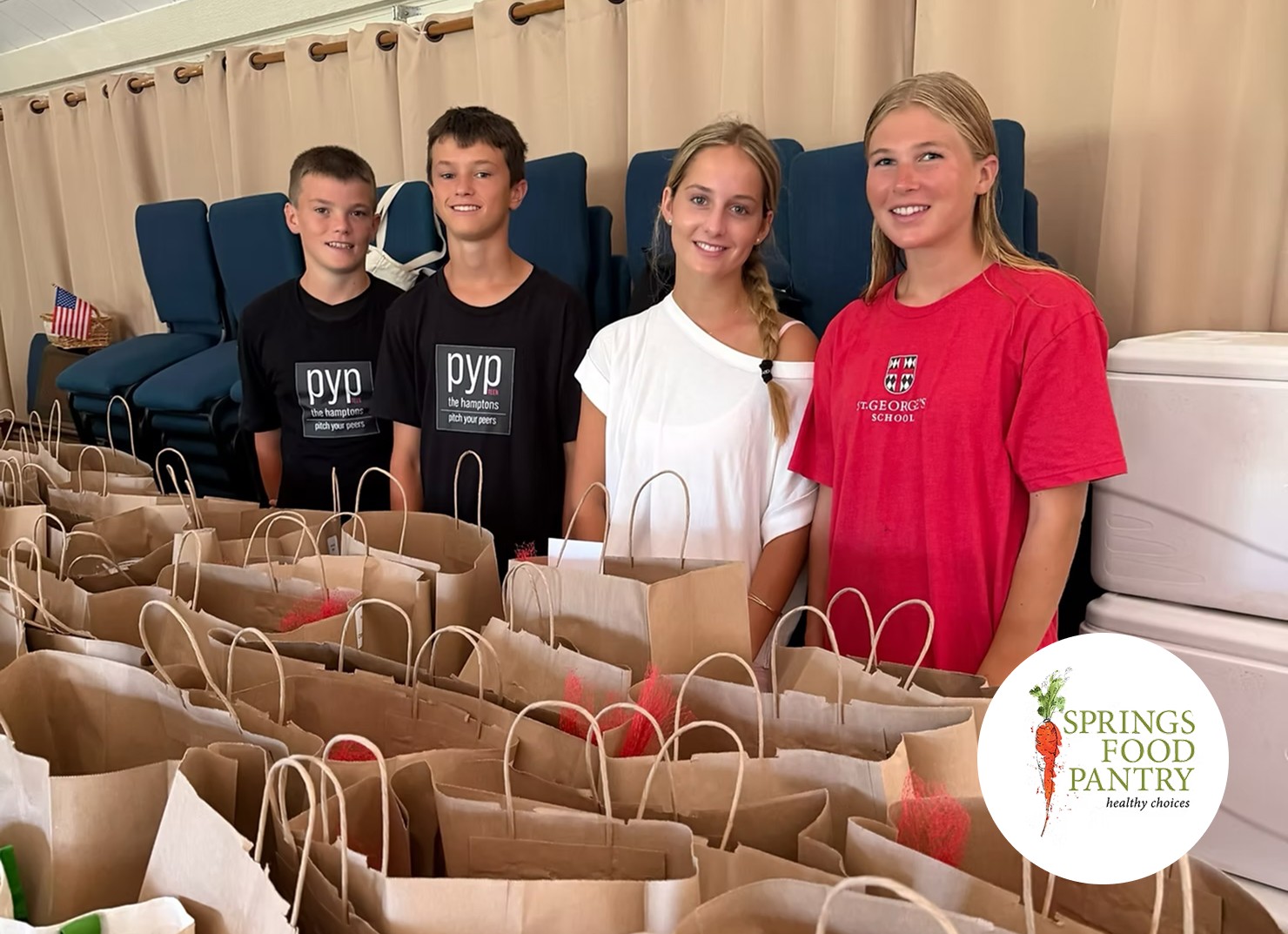
Springs Food Pantry created their Summer Lunch Program to answer this. It runs nine weeks, ending just before Labor Day. Registered families receive a weekly bag built for their children, with enough food for three lunches: easy-to-prepare proteins, organic juice, healthy snacks, and a few treats, because they are kids. Bags are packed to fit the household, one child or four. And this year, each bag carries a handwritten note. The notes come from the Pantry's Sitting Crew, older volunteers who do their work seated so that they can keep doing it. Some of the oldest hands in Springs, writing encouragement to its youngest.
This summer that means roughly 185 families and more than 300 children, each bag packed by high school volunteers from ReWild South Fork.
The Farm Piece
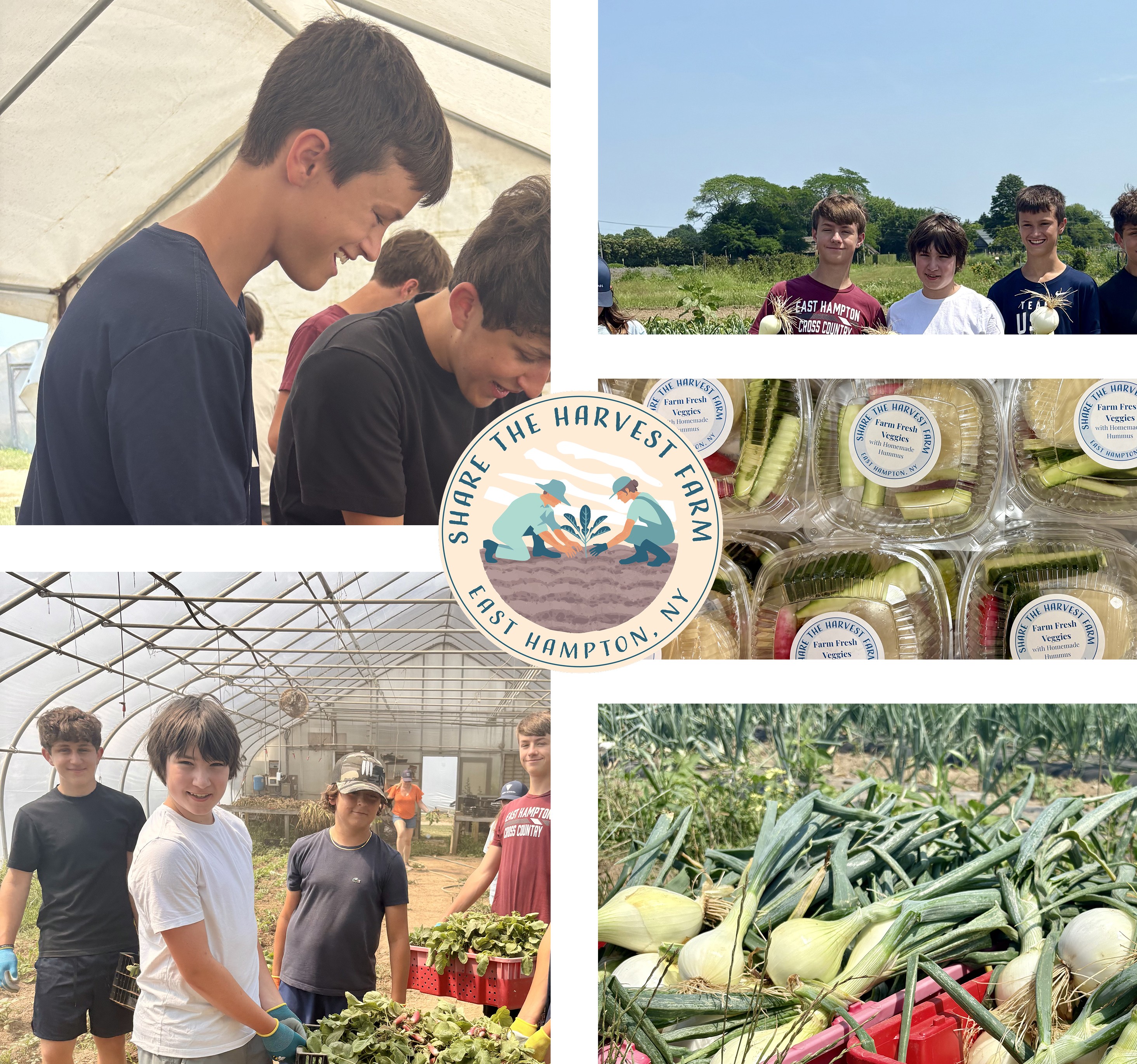
Share the Harvest Farm and Springs Food Pantry are not new to each other. The farm was the first to donate produce to the Pantry, back in 2010, and today it supplies almost a dozen community partners across the East End. But the Summer Lunch Program presented a problem that produce donations alone had never solved: there was rarely enough to go around, and you cannot hand a child a zucchini and expect them to know what to do with it. So this year, for the first time, fresh vegetables are going into the children's bags, prepared so kids can actually eat them, and the farm built its part of the program to make that happen.
It runs in two parts. On Tuesdays, young people from Pitch Your Peers Teen, who recruit and coordinate the volunteers themselves, come to the farm to harvest, then move to the kitchen, where Chef Nikki Glick guides them through washing, packing, and turning what they picked into dips and vegetable sides. On Wednesdays they return to the Pantry to help hand bags to families.
That is the part Carte Blanche funded: the cost of the farm's participation, so that supporting this program never has to compete with running the farm.
Why We Said Yes
We have partnered with Share the Harvest Farm since 2024. We fund their general operations, which is another way of saying we trust them to know what they need. When something specific has come up, a tractor, repairs to the hoop house, a drying shed, we have funded that too, and every time, executive director Meredith Arm and farm manager Matthew Quirk turn the investment into more than anyone asked of it.
They even named the tractor Blanche.
We have watched them build something that keeps reaching further into its community without losing the thing that makes it work, which is proximity. They know the people they serve, and they are always looking for the next way to give more.
So when Meredith brought us the opportunity, we didn't need to think about it long.
The fresh produce is the obvious win. The quieter one is the teens: young people from this community spending a season not just in community care but on the farm itself, learning the work, and learning what food insecurity looks like in the community they call home. And the model is already traveling: other food pantries have asked about bringing it to their own families next summer.
Share the Harvest knows the Pantry, the Pantry knows its families, and the teens who picked the vegetables are the ones handing over the bags. Our job was only to make sure the farm could afford to say yes.
Somewhere in Springs it is noon on a Wednesday. A nine-year-old boy is opening a bag that was packed for him, and near the top, above the juice boxes, the snacks, the fresh produce from a farm nearby, and the few things in there purely because he is a child, there is a note from someone he has never met telling him that his community is thinking of him.
If you visit the Hamptons this summer, we hope you eat well. And if you have a few dollars left over, consider supporting the Summer Lunch Program through Share the Harvest Farm, just below.
We are not the only ones who noticed!
The East Hampton Star published a story on the farm and the Summer Lunch Program: From Farm Fields to Food Pantry
Author
Bonnie Hudson
Executive Director